

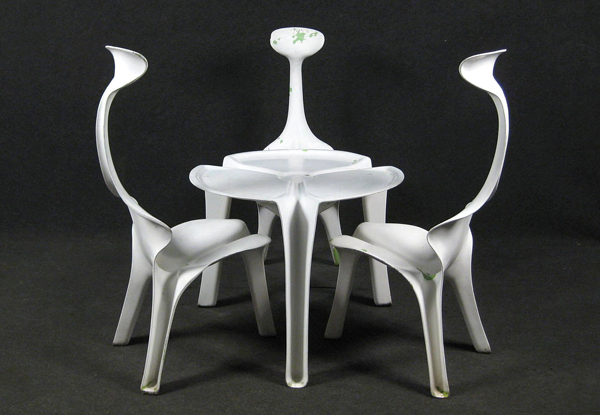
Design Enters the Plastic Age
In the 1970s, one material dominated the imagination: plastic.
Although it had already been invented at the end of the 19th century, advances in technology and industrial manufacturing processes allowed it to become widely established in domestic interiors. After the austerity of the post-war years and the reconstruction period of the Trente Glorieuses, Europe embraced a more joyful, colourful and liberated form of modernity.
As Richard Thommeret, chemist and author of Plastiques et design (Eyrolles, 2013), explains: “Plastic, developed since the end of the 19th century, entered a phase of industrial expansion in the 1970s.” More than simply a material, it became the symbol of an era defined by the breaking down of social conventions, changing lifestyles and the democratisation of consumption.
A Material Synonymous with Freedom
In the home, plastic gradually began to replace wood, glass and metal. Formica, PVC, Plexiglas (PMMA) and polyurethane opened up entirely new possibilities. Designers discovered that they could create unprecedented forms, vivid colours and more intuitive ways of using objects.
Art critic Pierre Restany wrote in 1973 in Le plastique dans l’art: “Plastic is more flexible than glass and just as transparent, more supple than wool and just as soft as cotton.”
This malleability appealed strongly to designers: tables with vibrant transparent surfaces, futuristic seating and sculptural lighting. Plastic embodied modernity: mobile, lightweight, modular and affordable. It also represented a certain idea of democratic luxury, accessible to a wider audience without sacrificing boldness.
Furniture Becomes a Field for Experimentation
The 1970s were a decade of radical experimentation. Polymers became a playground for inventive designers determined to push the boundaries of form.
Ugo La Pietra created his transparent PMMA “cylinder and sphere” lamps in 1968–1969; Joe Colombo designed his polyurethane chaise longue in 1969, both futuristic and ergonomic; K. Gôhling conceived the inflatable Blow-Up armchair in 1969, a translucent PVC bubble that anticipated the rise of inflatable design; while Busnelli produced the Libro armchair in 1970, combining rationality with flexibility.
Through such designs, plastic made possible what had previously been difficult or impossible: furniture that was lighter, mobile, stackable, suitable for mass production and accessible to a much broader public.
The Panton Chair, an Icon of Formal Freedom
Among all these innovations, the Panton Chair remains the ultimate icon. As early as 1959, Danish designer Verner Panton dreamed of creating a chair moulded in a single piece.
After several prototypes in wood and rigid foam, he succeeded in 1967, together with Vitra, in launching the first injection-moulded plastic chair reinforced with fibreglass. “I wanted to create a chair that looked as though it had been poured like water,” Panton explained.
As production techniques evolved — coloured thermoplastic in 1970, polyurethane in 1983, and recyclable polypropylene from the 2000s onwards — it became one of the most emblematic chairs in 20th-century design: ergonomic, stackable, colourful and accessible. A genuine formal and cultural revolution.
Legacy and Contemporary Debate
Today, plastic inspires as much criticism as fascination. In a context marked by a renewed interest in natural and sustainable materials, its image has often been tarnished by environmental concerns.
Yet it remains omnipresent in design, increasingly in recycled or recyclable forms. Philippe Starck’s La Marie chair (1999), made from transparent polycarbonate, demonstrated that plastic could still be both desirable and timeless.
While history remembers the excesses of mass consumption, it also recognises how deeply plastic transformed our relationship with objects. It allowed designers to free their imagination, democratised access to design and gave an entire generation the sense that modernity could be colourful, joyful and accessible.
Towards a New Perspective on Plastic
Today, as design increasingly turns towards sustainable materials and environmentally responsible production methods, the plastics of the 1960s and 1970s are being viewed in a different light. They still crystallise criticism surrounding pollution and overconsumption, but vintage pieces have also demonstrated their durability and longevity.
A well-maintained polyurethane armchair or ABS chair can survive for decades without losing its visual impact.
Restoring, preserving and reusing these vintage objects has therefore become a responsible way of extending their life cycle and giving them renewed value within contemporary interiors. Plastic, once a symbol of boldness and experimentation, can now also form part of a circular approach in which heritage and environmental awareness come together.